Border Journalism Network
Border Journalism Network
Leading Mexican intellectual visits Tucson to garner U.S. support for peace movement
By Kevin G. Andrade, University of Arizona
On March 28, 2011, Javier Sicilia joined the ranks of thousands of other parents in Mexico. His son, Juan Pablo, was killed in Temixco, Morelos State in the midst of mounting violence in various parts of the country.
Sicilia’s story of parental loss has been repeated thousands of times over the past six years. In December 2006, shortly after taking office, President Felipe Calderón Hinajosa declared an all-out war on drug traffickers. Since then, estimates range between 54 thousand and 60 thousand dead as a result of fighting. That act has taken a huge toll on this country of 112 million. In addition, more than 1.6 million people have been displaced.
In an open letter to Mexico’s politicians and criminals, he renounced poetry, declaring, “poetry no longer exists in me.”
The protest movement he launched, titled, “Estamos hasta la madre,” loosely translated as “we’ve had enough!,” drew thousands out into the streets last year.
These are the roots of the organization that Sicilia leads, El Movimiento por la Paz con Justicia y Dignidad (Movement for Peace with Justice and Dignity), which he plans to bring north of the border this August. Sicilia spoke at the University of Arizona in Tucson about the importance of the movement here.
“This war,” he said in a public speech, “has its origins in the United States. It’s called the War on Drugs.”
Since 1971, when President Richard Nixon declared the “War on Drugs,” it has played an integral part in relations between the United States and Latin America.
“What is happening with Mexico,” says Marcela Vasquez-León, a professor of Anthropology and Latin American Studies at the University of Arizona, “is nothing new.”
The United States has taken a militarized approach when it comes to the issue of drug production and trafficking from Latin America to the United States. In Mexico, this focus resulted in the Plan Merida.
Established in 2008, the Plan Merida, allocated $1.8 billion in U.S. government aid to Mexico in order to combat the cartels. These funds are earmarked to improve police and military capabilities. Strings are often attached in the form of U.S. military advisers to train the groups receiving aid.
In July 2011, Gian Carlo Delgado-Ramos and Silvina María Romano published results from their study, which found that Plan Merida increased Mexico’s defense spending by 125 per cent since its establishment in 2008. It is modeled on Plan Colombia, and its successor, the Andean Initiative, designed to reduce the influence of illicit drugs in Colombia.
More than $3 billion have been invested in Plan Colombia. The vast majority of funds going towards the military to aid in the Southern Push strategy pursued by Alvaro Uribe during his presidency from 2002-2010, which weakened Colombia’s largest guerrilla movement, the FARC.
As part of the strategy, a massive aerial fumigation campaign began. In the year 2007 along, 85,000 hectares of countryside were fumigated. The objective was to reduce the cultivation of coca but there has been no real reduction and the only effect has been to destroy the livelihoods of thousands of residents in the countryside and forcing them to the cities. In addition, it has had a huge effect on the ecosystem and health of residents there.
Such policies, says Sicilia, have their origins in the United States and this has to be brought to the public’s attention.
“I came with the goal of bringing to the conscience of the American people and their politicians of the effects of the War on Drugs,” said Sicilia in an interview with the Border Journalism Network. “Drugs [policy] needs to be changed to a public health issue.”
In addition to the issue of drug policies, there is another source of violence that stems from north of the border. The U.S. Bureau of Alcohol, Tobacco and Firearms found that between 2007 and 2011, 68,000 guns seized in Mexico originated in the United States.
This is a major issue says Sicilia.
“They [the US] need to change their arms policies, their hemispheric control over arms, because their drugs policy, this War on Drugs, and the arms which are illegally entering Mexican territory, are destroying Mexico.”
In order to generate support from U.S. citizens about the issue, Sicilia plans to lead a march through Tucson on August sixth, as part of a peace caravan from Tijuana/San Diego to Brownsville/Matamoros. Such acts have garnered support from humanitarian workers and groups on both sides of the border.
“I hope that all people who wish to will participate in this Movement for Peace,” says Father Ricardo Machuca Hernandez of the Kino Border Initiative, a group that helps migrants in Nogales, Sonora. “It’s something needed not just by Mexico and the United States. It’s like a little grain of sand that will contribute to growing the peace which all desire.”
The tragic loss of his son has certainly made Sicilia a more public figure. This is a role which he takes on, but not of his own volition.
“If no one says anything about the pain of Mexicans, we won’t be able to do anything about it.”
With his son gone, but never forgotten, Sicilia marches on. He marches for peace in hope that other parents won’t have to feel his hurt.
University librarian keeps tally of the murders in Juárez, Mexico
May 21, 2012
By Virginia Isaad for El Nuevo Sol de California State University, Northridge

Molly Molloy/ Photo by Theresa Westbrock
Living 50 miles from one of the most dangerous cities in the world, Molly Molloy has taken on the grisly role of keeping count of the murders in Juarez, Mexico.
As New Mexico State University (NMSU) librarian and Border & Latin American Specialist, Molloy, 56, held an interest in the so-called war on drugs and the lack of in-depth coverage it received.
In 2009, she began hosting a newsgroup through Google groups, which has now accumulated nearly a thousand subscribers mainly consisting of academics and journalists interested in border issues. By pulling information from sources such as El Diario de Juarez, Molloy provides her subscribers with detailed accounts of events generally glossed over in other media outlets.
The reason for the violence is commonly attributed to Mexican President Felipe Calderon’s call to war against the drug cartels, however, little is said of the effects of NAFTA that led to the loss of jobs and the Merida Initiative, which continues to funnel millions of dollars to the Mexican military. The increase in poverty in this border region and the rise of corrupt government officials has created an environment for illegal activity to thrive thus perpetuation the violence.
“I think that most US coverage is pretty shallow and seems almost always based on the latest press releases from Mexican government entities. Of course when there is a high-profile event like a massacre, multiple homicides, atrocities with narco-banners, etc., there is a flurry of wire service coverage, but there is almost never any follow-up,” said Molloy. “ Also, I know that there are many reporters from major media based in Mexico, almost all of them in Mexico City.There, they have access to the major government agencies, cabinet officials, etc. What they do not seem to have is access to local and state officials in areas where the worst violence occurs. There is seldom any reporting from rural areas.”
Read the full story at El Nuevo Sol
Check out our coverage of the border at El Nuevo Sol-Frontera
Puro Borde murals show the colors of hope in the border cities
May 17, 2012
By Annette Baca for Borderzine.com, University of Texas at El Paso
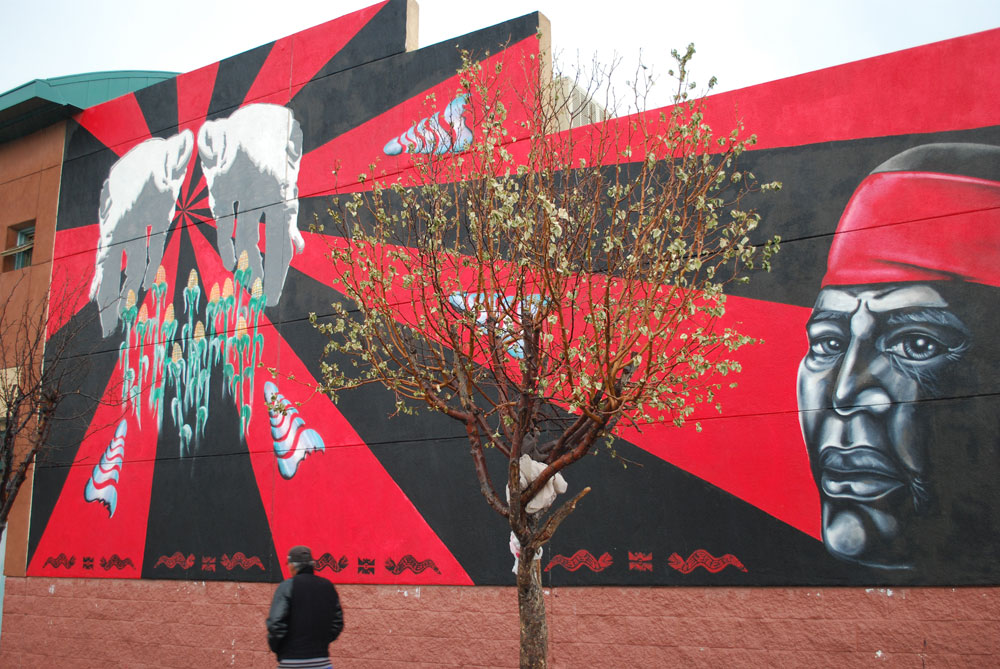
Centro de Trabajadores Agrícolas Fronterizos at Oregon St. and 9th St. (Annette Baca/Borderzine.com)
EL PASO – Local artists from El Paso and Ciudad Juarez have joined together in a network that spans the border, dedicated to painting the streets of both cities with hopeful art to refocus the minds of many who see this area as a war zone.
The network known as Puro Borde, consists of more than two dozen artists from the El Paso-Juarez area who help each other exhibit their murals, turning their cities into more colorful communities. They also place their work in local galleries.
Self-described “border artist” Arón Venegas, is a member of Puro Borde in El Paso who believes that art communicates with power. Venegas, a graduate of the University of Texas at El Paso, has worked on a variety of murals with Puro Borde and has exhibited his work in both Mexico and the U.S.
As for creating a sense of pride in a community through public art, Venegas suggests that a single mural cannot have the power that many with the same objective can. “Art that is not public is not worth doing,” Venegas said. In his opinion, art should serve the community. He explains that a mural is an interactive and collective process from beginning to end.
Apparently there is not much sense of a divide between the artists from Juarez and those from El Paso.
More than a million border residents suffer from diabetes
April 27, 2012
By Idalí Cruz for Borderzine.com, University of Texas at El Paso
CIUDAD JUÁREZ – After 20 years with diabetes, she lives her life in bed, watching her favorite soap operas on T.V., occasionally talking to her husband or asking for something she needs.
After suffering kidney failure four years ago Guadalupe Vargas, 62, needs peritoneal dialysis every four hours to clean her nonfunctioning kidneys. “My life is not the same anymore. I can’t do anything. Diabetes also affected my eyesight. I have glaucoma.”
Vargas is not suffering alone. A survey entitled Diabetes Prevalence Study conducted by the U.S. Centers for Disease Control and Prevention and the Mexico Secretariat of Health showed that 1.11 million inhabitants of the border region suffer from diabetes – 40% of adults in the Mexican border states and 11.6% of adults in the U.S. border states.
Rodolfo Elias, an epidemiologist at clinic number 48 of the IMSS the Mexican Social Security Institute said that the two main diseases that are looked after in the clinic are hypertension or high blood pressure, and diabetes. “Approximately 10% of all the patients that are looked after in the clinic have diabetes.”
The struggle for ethnic parity in U.S. media started with the American Revolution
April 20, 2012
By Kristian Hernandez for Borderzine.com, University of Texas at El Paso

Joseph Torres, Latino journalist and author of News for all the People visits UTEP on April 17 to educate students about the history of ethnic media. (Danya P. Hernandez/Borderzine.com)
EL PASO—A modern day champion for a free press, fighting to maintain and safeguard the lessons learned and taught by persons of color in the history of American journalism made his way south to this border city.
Latino author and journalist Joseph Torres stood before students at the University of Texas at El Paso on April 17 and asked them, “Who was Ruben Salazar?” The classroom full of aspiring young Latino journalist grew silent.
Surprised by their silence, he explained how a boy from their own border town became one of the most important Chicano journalists in the 1960’s and how his voice was violently silenced in 1970 by police in Los Angeles.
“What most people don’t know about him is that he tried to organize the Latino community and journalists to become activists to create change,” said Torres before reading a rare quote by Salazar that could be a clue to the speculations surrounding his death.
 Border Journalism Network