Border Journalism Network
Border Journalism Network
In Hereford, Glenn Spencer uses state-of-the-art equipment to find border-crossers
December 2, 2010
By Samantha Sais for the Tucson Weekly
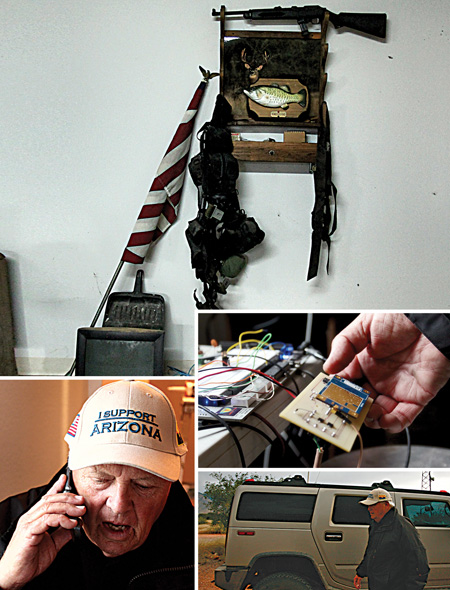
Photo by Samantha Sais
HEREFORD, ARIZ.—Glenn Spencer is the president and founder of the American Border Patrol. His organization, an immigration-watchdog group, has been in operation for seven years.
On the afternoon of Oct. 15, Spencer took a reporter and me on a tour of the border fence that runs along his property. This is the section that he patrols regularly.
Spencer and his organization have spent more than a million dollars of mostly donated funds to equip his ranch with monitoring devices that allow him to keep tabs on crossing activity.
The equipment ranges from military-grade weapons to high-tech monitoring devices like thermal cameras, seismic sensors, experimental planes and recording devices.
Jackson Heights, N.Y., may be a model for immigrant diversity
December 2, 2010
By Juliana Vasquez for the Tucson Weekly

photo by Juliana Vasquez
NEW YORK — A stroll down Roosevelt Avenue up to 37th Avenue in Jackson Heights, N.Y., is like walking into the world at large.
An Indian sari shop here, a Bangladeshi market there; across the street, an Argentinean steakhouse.
A table covered with glittering, iridescent Indian-style scarves and shawls sits outside of a shop on 37th just below a jewelry store. Ali Wagar, the owner, stands outside, watching and waiting for his next customer as people rush by on the always-busy New York streets.
“The great part of the immigrant majority here,” Wagar said, “is that they all contribute great things to the community.”
While the illegal-immigration debate continues to divide communities across the country, havens for immigrant businesses like Jackson Heights in Queens, N.Y., shed light on the successes and challenges of immigrant integration.
An undocumented existence: Julio Bonilla has crossed the border many times to find a better life
December 2, 2010
By Samantha Sais for the Tucson Weekly

Photo by Samantha Sais
NEW YORK—Julio Bonilla lives and works in East Harlem, N.Y., as a busboy and deliveryman for Pipo’s II Mexican Restaurant.
Bonilla, an undocumented immigrant from Mexico, has joined the thousands of Mexicans who now call East Harlem home, making the Puerto Rican-dominated neighborhood into what is now known as “Little Mexico.”
In the last 20 years, more than 12,000 Mexican immigrants have moved into the community, according to U.S. Census data.
The peak season for people to cross the U.S.-Mexico border in Arizona is January through June, said David Jimarez, an agent in the U.S. Border Patrol’s Tucson Sector.
The Border Patrol’s Tucson Sector is responsible for 262 miles of Arizona-Mexico border, he said. The Yuma Sector patrols the remaining 127 miles.
In fiscal year 2009, the Tucson Sector reported 241,000 apprehensions—which is less than half of what it was in 2000.
Crossing used to be much easier, said Bonilla, who crossed the border through Nogales.
No papers, no future
December 2, 2010
By Kirsten Boele for the Tucson Weekly
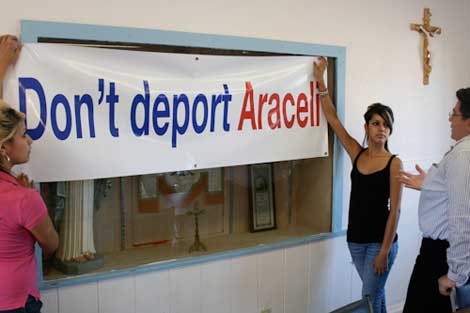
Photo by Kirsten Boele
Erika Toledo Ruiz, 19, relaxes on a comfortable couch with her little sister, Gloria. While their dad naps after his midnight shift at McDonald’s, a big flat-screen TV entertains the girls with blaring American cartoons. Gloria plays with the leftovers of a McFlurry as Erika gets ready to pick up her mom from her diner job.
Erika wants to work in the restaurant business as well. She graduated from Pueblo Magnet High School last year and is saving money to enter the culinary arts program at Pima Community College next year.
“When I get my diploma, I want to start business management so that I can get my own restaurant,” Erika says. “That is my big dream. Hopefully, it comes true.”
But there is one major obstacle: She does not have the right papers to stay in the United States legally.
On the other side of the country, New Yorker Sonia Guinansaca also lives an undocumented life. However, if the Development, Relief and Education for Alien Minors (DREAM) Act becomes law, Erika, Sonia and almost a million other undocumented young people in the United States could continue their education and follow their dreams.
Orfanatorio en Tijuana ofrece amor y esperanza a niños con familias en ambos lados
12 de julio de 2010
Por Cindy Von Quednow para El Nuevo Sol de California State University, Northridge

Lalo es uno de los más pequeños de los 85 niños del orfanato. Adolfo Flores / El Nuevo Sol
Una confusión de papeles en la frontera entre México y Estados Unidos hizo que Berenice Rodríguez, una joven de 21 años, nunca viera a su familia de nuevo.
Cuando tenía nueve años, ella y su hermana de 19 viajaron de paseo desde Los Ángeles a México mientras sus padres estaban de viaje. De regreso a EE.UU., Berenice, quien nació en Guadalajara, trató de cruzar la frontera de Tijuana con papeles de otra niña (la hermanita del novio de la hermana) pero no pudo. La separaron de su hermana y la llevaron a una casa de inmigrantes.
“Fue así como nos separaron en ese momento y no supe adónde exactamente la mandaron a (mi hermana)”, recuerda Berenice, quien ahora tiene 21 años. “En ese momento todos los lazos… se me rompieron”.
 Border Journalism Network